SEO pluginy

SEO Friendly WordPress in 12 Steps »

Pozn.: Přidávat k příspěvkům a stránkám vlastní *titles* a *descriptions* lze i bez pluginu, prostřednictvím metaboxů resp. uživatelských polí

Platinum SEO Pack
http://wordpress.org/extend/plugins/platinum-seo-pack/

This plugin is based on All-In-One SEO Pack, but added some extra functionality for those who really want to get their hands dirty in the SEO machine. This plugin allows you to define not just noindex/index for each page, but also follow or nofollow, noarchive, nosnippet, noodp, noydir… Quite the array of options. My favorite part? They tell you, “don’t be afraid to change your permalinks” – they’ve added a 301 redirect capability so you won’t lose page rank.

WordPress SEO by Yoast
http://wordpress.org/extend/plugins/wordpress-seo/

Nice detached admin page, explanations with loads of options, quite a few added features (like authentication for google webmasters or breadcrumbs). Forces you to choose a focus keyword when you’re writing your articles, and then makes sure you use that focus keyword everywhere. WordPress SEO has the most advanced XML Sitemaps functionality in any WordPress plugin. Once you check the box, it automatically creates XML sitemaps and notifies Google & Bing of the sitemaps existence.

The clear winners and real all in one seo alternatives are WordPress SEO by Yoast and „Platinum SEO Pack“::http://wordpress.org/extend/plugins/platinum-seo-pack/, but for diferent reasons, if you want a clean, simple SEO option for WordPress i would go with Platinum SEO Pack, it has everything you need, but if you want a bit of an edge and more options and better understanding of the features, then i would go with WordPress SEO by Yoast.

All-In-One SEO Pack
http://wordpress.org/extend/plugins/all-in-one-seo-pack/

This tool only requires you to define your desired meta information, keywords, and some select niceties (defining noindex for category pages, tag pages and archives), and you’re done. Literally one of the most simply effective tools for SEO.

SEO Ultimate
http://wordpress.org/extend/plugins/seo-ultimate/
http://www.seodesignsolutions.com/wordpress-seo/

SEO Ultimate is a powerful all-in-one SEO plugin, available free for WordPress bloggers. Take control of your on-page SEO with user-friendly settings and tools for optimizing your titles, meta data, robots tags, canonicalization, autolinks, post slugs, and much more.

HeadSpace 2
http://wordpress.org/extend/plugins/headspace2/
http://urbangiraffe.com/plugins/headspace2/

Controls almost every aspect of your site’s meta-data, including advanced tagging, Analytics, and dozens of plugins.

You can configure meta-data for:

– Posts
– Pages
– Categories
– Home page
– Author pages
– Search pages
– 404 page

You can define:

– Tags/keywords, with suggested keywords
– Descriptions
– Page titles
– Custom ‚more text‘
– Site name and site description
– Custom themes – change your theme on each page!
– Custom plugins – load a plugin only on specific pages
– Additional CSS and JavaScript files
– Noindex and nofollow meta tags
– Follow/follow on archive, category, page, tag, and comment links

Srovnání výše uvedených pluginů »

SEO Nova
http://www.seoinc.com/seo-nova/

SEO Nova can easily be defined as the WordPress SEO solution for bloggers at any level of experience. SEO Nova offers all the amazing features of its top predecessors plus so much more. Deciding to pursue developing a WordPress plug-in was an easy choice. Too many friends, clients and colleagues seem to experience similar annoyances. Using alternative WordPress SEO plug-ins just didn’t provide enough instructional content, understandable feature descriptions, let alone optimization advice.

SEO Friendly Images
http://www.prelovac.com/vladimir/wordpress-plugins/seo-friendly-images

Yet another little plugin with a simple task that provides a wealth of functionality. By adding an “alt” and “title” description to all of your images, SEO Friendly Images is able to describe your photos and images to search engines, allowing them to more easily crawl your content.

Porovnání SEO pluginů by Yoast »

Which Is The Best SEO Plugin by Elegant Themes »

50 nejlepších SEO pluginů pro WordPress »

Změna z příspěvků na stránky nebo naopak

Vice Versa
http://wordpress.org/extend/plugins/vice-versa/

Vice Versa allows you to easily convert WordPress Posts to Pages and Pages to Posts. You can also assign a Page or Post a parent or category(s) as you are converting from one to the other. Vice Versa is easy to install and use. No database tables are affected during installation and there are no additional settings required for the Vice Versa to work.

Automatizace instalace a konfigurace

Core Tweaks WordPress Setup
http://wordpress.org/extend/plugins/seo-automatic-wp-core-tweaks/

This plug-in completely automates the proper setup of your WordPress blog for search engine optimization. Primarily for use in new WP installations.
Almost everything is covered, from changing the permalink structure to deleting the Hello World sample post and comment. All the options are accessible from one single page.

*Související:*
Hromadná instalace pluginů

*Další informace k automatické instalaci a konfiguraci:*

http://wpbits.wordpress.com/2007/08/09/automating-wordpress-customizations-the-plugin-way/
http://wpbits.wordpress.com/2007/08/10/automating-wordpress-customizations-the-installphp-way/

Vkládání předpřipravených bloků textu/html

Contemplate
http://wordpress.org/extend/plugins/contemplate/
http://www.presscoders.com/plugins/contemplate/

Easily manage common blocks of text/html content in your posts, pages, widgets, and comments. Useful for announcements, information, adve
It is designed to save you time by managing commonly used blocks of content (text, HTML, CSS, or Javascript) that you want to appear across your site. Content templates can be used in posts, pages, widgets, and comments. Simply define the content templates in the plugin options page and then insert them anywhere on your site by adding a shortcode in the place where you want content to appear.

Vytvoření e-shopu

DukaPress
http://wordpress.org/extend/plugins/dukapress/
http://dukapress.org/

DukaPress is open source software that can be used to build online shops quickly and easily. DukaPress is built on top of WordPress, a world class content management system. DukaPress is built to be both simple and elegant yet powerful and scalable.

The main reason why we chose to build DukaPress instead of using already existing platforms was because no other WordPress based e-commerce tool provides its users with what we feel are essential features of an e-commerce system. With DukaPress, we have made these features both free of charge and simple to use.

– You can sell tangible regular products;
– You can sell tangible products with selectable options (size, colour, etc);
– You can sell digital products;
– Choose between a normal shop mode and a catalogue mode;
– Numerous payment processing options including Paypal, Alertpay and Mobile Phone payments;
– Ability to work with multiple currencies
– Printable invoices;
– One-page checkout;
– Elegant discount coupon management;
– A myriad of shipping processing options;
– Simple user management and customer order logs;
– Custom GUI (Graphical User Interface) for product management;
– Easy to translate into your own language

Poznámky pod čarou

Simple Footnotes
http://wordpress.org/extend/plugins/simple-footnotes/
http://andrewnacin.com/2010/07/10/new-plugin-simple-footnotes/#note-327-1

Create simple, elegant footnotes on your site. Use the [ref] shortcode and the plugin takes care of the rest.

Example usage: Lorem ipsum. [ref]My note.[/ref]

If you paginate your posts, you can optionally move your footnotes below your page links. Look under Settings > Reading. Footnotes will still appear as normal for posts that are unpaginated.

*Alternativa*

WP-Footnotes
http://wordpress.org/extend/plugins/wp-footnotes/

Allows post authors to easily add and manage footnotes in posts.
Easily add footnotes or sidenotes to any post using a simple mark-up which degrades (kind of) gracefully in the event that for some horrifying reason this plugin nolonger works.

Různé typy příspěvků, taxonomie, metaboxy

Custom post types in WordPress »

A refresher on custom taxonomies »

Introducing WordPress 3 Custom Taxonomies »

Innovative Uses of WordPress Post Types and Taxonomies

Custom Fields 101: Tips, Tricks, and Hacks »

Publish Action Hook for Custom Post Types »

WordPress Custom Taxonomy Input Panels »

Revisiting Custom Post Types, Custom Taxonomies, and Permalinks »

WordPress Custom Post Type Code Generator »

“ rel=“noopener noreferrer“>How To Create Custom Post Meta Boxes »

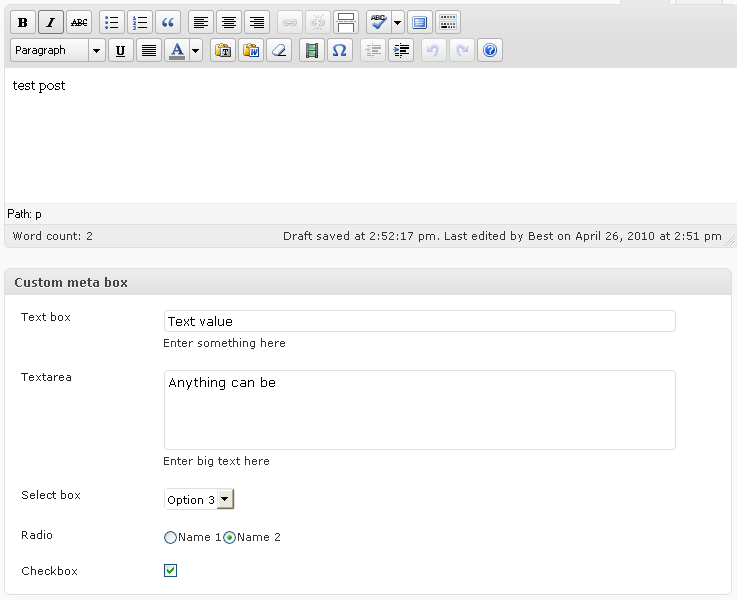
Using custom meta box is a great way to make custom fields more friendly to users. It helps us much to add extra information to a post.

Viz též Add A Meta Box In WordPress »

Custom Post Type UI
http://wordpress.org/extend/plugins/custom-post-type-ui/
http://webdevstudios.com/support/wordpress-plugins/

This plugin provides an easy to use interface to create and administer custom post types in WordPress. Plugin can also create custom taxonomies. This plugin is created for WordPress 3.0.

WP Easy Post Types
http://wordpress.org/extend/plugins/easy-post-types/

This plugin lets you take advantage of the WordPress 3.0 custom post type feature, and create your own post type. The plugin allows you to add a set of fields attached to your new post type, so that in the edit and add new windows a new box will show with the fields defined. Each field added will be saved in the WordPress Database as a custom field, so that you can take advantage of the standard WordPress query rules to list your content on the page template.
Not only can you create and manage new post types but you can create and manage custom fields and meta boxes associated with a particular post type. It comes with a built-in date picker field to help with post types that are date-specific. Another key feature giving this plugin loads of potential is that it allows you manage the admin display of your created post types. For instance, if you wanted a custom field to show up in the posts list screen, you can do that.

Post Type Switcher
http://wordpress.org/extend/plugins/post-type-switcher/

A simple way to change a post type in WordPress (one at a time). Any combination is possible, even custom post types.

– Page to Post
– Post to Page
– Post to Custom
– Post to revision/attachment/navigation menu is possible but turned off by default

Convert Post Types
http://wordpress.org/extend/plugins/convert-post-types/

This is a utility for converting lots of posts or pages to a custom post type (or vice versa). You can limit the conversion to posts in a single category or children of specific page. You can also assign new taxonomy terms, which will be added to the posts‘ existing terms.

*Další informace:*

A WordPress forum plugin using custom post types
The Essential Guide to WordPress 3.0 Custom Taxonomies

First Impressions of Custom Post Type
Function Reference/register post type
Custom Post Types in WordPress 2.9
How To Make WordPress An CMS With Different Post Types
Developing Post Types Plugin with WordPress
How to Set Up Custom WordPress Category Templates
Creating single post templates in WordPress
WordPress Single Post Templates

Konfigurace

Wp-config.php is the single most important file in your entire WordPress installation. This file can be used to configure database functionalities, enhance performance, and improve security on all WordPress powered websites and blogs.

Debugging WordPress

For developers, WordPress has this awesome debugging feature which allows them to find errors, and deprecated functions. By default, this function is set to false, but in the development mode, developers should have it enabled.


define('WP_DEBUG', false); // disable debugging mode by default
define('WP_DEBUG', true); // enable debugging mode

Blog/Site Address

In your WordPress Settings, you specify the WordPress address and the site address. Those are added in your database, and every time the developer calls it in the template, it is running a database query. In WordPress 2.2, these two settings were introduced to override the database values without changing them:


define('WP_HOME', 'http://www.wpbeginner.com');
define('WP_SITEURL', 'http://www.wpbeginner.com');

By adding these in your wp-config.php, you are reducing the number of database queries thus increasing your site’s performance.

Override File Permissions

You can override file permissions, if your host has restrictive permissions for all user files. Most of you do not need this, but it exists for those who need it.


define('FS_CHMOD_FILE', 0755);
define('FS_CHMOD_DIR', 0644);

Post Revisions

In the recent versions of WordPress, there is a super awesome feature called Post Revisions. This function auto-saves posts just incase if your browser crash, or something else happen. It also allows users to restore back to previous versions if they don’t like the changes and so on. While a lot of us love this feature, some of us really hate it with a passion. This function has numerous configuration, so you can make it work just right for you.
By default WordPress saves post every 60 seconds, but if you think that is way too much, then you can modify it to your likings with this configuration:


define('AUTOSAVE_INTERVAL', 120); // in seconds

Some posts have 10s, 20s, or even 100 post revisions depending on the blog owner. If you think that feature annoys you, then you can limit the number of revisions per post.


define('WP_POST_REVISIONS', 5);

You can use any integer you like there.

If none of the settings above satisfies you, then you can simply disable the post revisions feature by adding this function:


define('WP_POST_REVISIONS', false);

WordPress Trash Feature

In WordPress 2.9, there was a new “Trash” feature added to the core. This feature works just like the recycling bin, so instead of deleting the post permanently, you would send it to the trash. This helped those users who accidently click on Delete button, and it can be any of us. The bad part about this trash feature is that you have to empty the trash regularly. By default the trash empties itself every 30 days. You can modify that by using the following function:


define('EMPTY_TRASH_DAYS', 7 ); //Integer is the amount of days

FTP/SSH Constants

By default, WordPress allow you to upgrade plugins, and WordPress core versions from within the backend. There are some hosts that requires an FTP or SSH connection everytime you try to upgrade, or install a new plugin. By using the codes below, you can set the FTP or SSH constants and never have to worry about it again.


// forces the filesystem method: "direct", "ssh", "ftpext", or "ftpsockets"
    define('FS_METHOD', 'ftpext');
    // absolute path to root installation directory
    define('FTP_BASE', '/path/to/wordpress/');
    // absolute path to "wp-content" directory
    define('FTP_CONTENT_DIR', '/path/to/wordpress/wp-content/');
    // absolute path to "wp-plugins" directory
    define('FTP_PLUGIN_DIR ', '/path/to/wordpress/wp-content/plugins/');
    // absolute path to your SSH public key
    define('FTP_PUBKEY', '/home/username/.ssh/id_rsa.pub');
    // absolute path to your SSH private key
    define('FTP_PRIVKEY', '/home/username/.ssh/id_rsa');
    // either your FTP or SSH username
    define('FTP_USER', 'username');
    // password for FTP_USER username
    define('FTP_PASS', 'password');
    // hostname:port combo for your SSH/FTP server
    define('FTP_HOST', 'ftp.example.org:21');

Auto Database Optimization

In WordPress 2.9, there was a feature added called Automatic Database Optimization. To enable this feature, you would need to use the following function:


define('WP_ALLOW_REPAIR', true);

Once activated, you can see the settings on this page: http://www.yoursite.com/wp-admin/maint/repair.php
The user does not need to be logged in to access this functionality when this define is set. This is because its main intent is to repair a corrupted database, Users can often not login when the database is corrupt. So once you are done repairing and optimizing your database, make sure to remove this from your wp-config.php.

Increase PHP Memory Limit

There is a common WordPress Memory Exhausted Error that users have seen when activating some plugin. You can increase the PHP Memory Limit through wp-config.php file. Simply paste the code below:


define('WP_MEMORY_LIMIT', '64M');

Note: This feature may not work with some web hosts.

WordPress Error Log

For developers, it is useful to have an error log for a site. You can easily create a simple error log for a WordPress powered website by using wp-config.php file. First create a file called “php_error.log”, make it server-writable, and place it in the directory of your choice. Then edit the path in the third line of the following code:


@ini_set('log_errors','On');
    @ini_set('display_errors','Off');
    @ini_set('error_log','/home/path/domain/logs/php_error.log');

Also, for an error log, you should instead use these constants:


define( 'WP_DEBUG', true ); // Enables error reporting.
define( 'WP_DEBUG_DISPLAY', false ); // Hides the errors.
define( 'WP_DEBUG_LOG', true ); // Logs errors to wp-content/error.log (or use @ini_set('error_log') )

Automatické vysypání koše


define('EMPTY_TRASH_DAYS', 30 ); // Vysypání koše po 30 dnech

Přesunutí složky WP-Content


define( 'WP_CONTENT_DIR', $_SERVER['DOCUMENT_ROOT'] . '/newlocation/wp-content' );

nebo


define( 'WP_CONTENT_URL', 'http://www.yourwebsite.com/newlocation/wp-content' );

cesta k adresáři s pluginy


define( 'WP_PLUGIN_DIR', $_SERVER['DOCUMENT_ROOT'] . '/newlocation/wp-content/plugins' );
define( 'WP_PLUGIN_URL', 'http://www.yourwebsite.com/newlocation/wp-content/plugins');

Pokud nefunguje localhost a neznáme jméno DB serveru


define('DB_HOST', $_ENV{DATABASE_SERVER});

define('DB_HOST', $_ENV{DATABASE_SERVER});

Nezapomeňte konfigurační soubor zabezpečit

Abecední rejstřík

Index Press
http://wordpress.org/extend/plugins/index-press/

Provides a standard index of content in your site using a short code. Sorts results into alphabetical listings.

– Supports posts, pages, and custom post types – you select what to index.
– Provides options for adding styles to the index.
– Automatically indexes every time a page is saved.
– Allows admin to indicate words to omit from the index.

Jak deaktivovat pluginy mimo administrační rozhraní

If you installed the wrong plugin (usually unsupported or mis-configured but also malicious plugins) and got the dreaded blank screen of death with errors, don’t panic. Even though the Admin panel may not work, there’s still a emergency solution by executing one simple query in the database.
Simply execute this SQL query (perhaps through PHPMyAdmin):


// WP 2.9 and earlier
UPDATE wp_options SET option_value = '' WHERE option_name = 'active_plugins';

// WP 2.9 and later:
UPDATE wp_options SET option_value = 'a:0:{}' WHERE option_name = 'active_plugins';

Alternatively, if it’s not possible to change the database, you can also simply rename the /wp-content/plugins/ folder to disable all plugins.
This will disable all plugins in the WordPress installation. Rename it back after.
You just have to go back and enable all the working plugins and deleting the non-functional one.